This is an old revision of the document!
Table of Contents
Notes on New Translation of Popol Vuh: "The Trials & Death of One & Seven Hunter"
Overview:
This short selection is from a translation of the Popol Vuh (see bibliography). It involves the adventure and death of two “mythic” brothers. The Popol Vuh is a Quiche Maya book of creation. With pre-Columbian sources in oral tradition and possibly also in hieroglyphic writing, the surviving alphabetic text comes from a physical book presumed to have been written by a Native Mayan. The pieces were then likely transcribed and translated into Spanish in 1701. The Popol Vuh was not widely known until this translation was later published in 1941. It is this edition that gives us the text we have today. This is a text that emerges at a time of cultural change, perhaps adapting hieroglyphic and oral practices into the new, alphabetic medium.
Commentary:
This selection, from a lengthy and complex text, foregrounds the poetic quality of the larger piece. Poetic lines reflect the semantic sense (content) and structure (grammar) of the language. This follows Dell Hymes emphasis that the poetic form of oral poetry is essentially grammatical. There are no markers of how this might have been read, spoken, recited, chanted, or sung aloud.
An extensive introduction is contained in the 1996 Tedlock translation, reflecting a dramatic deepening of the scholarly understanding of ancient Mayan culture and their writing system. Based on his translation work and other factors, Tedlock explains that: “The authors of the alphabetic Popol Vuh were members of the three lordly lineages that once ruled the Quiché kingdom . . . They worked in the middle of the sixteenth century, and the scene of their writing was the town of Quiché, northwest of what is now Guatemala City” (25).
Context:
Mayan languages are spoken by six million people in modern day Mexico and Guatemala. There are 21 recognized Mayan languages today in Guatemala. The Quiche Mayan language descends from one of six branches. Some of these languages are known to have been exclusively written, hieroglyphic languages. This is an area of continued study, since much available writing survives only when carved in stone, meaning it must be excavated from ruins. Following the conquest of these countries, only reading and writing of Spanish was taught, so the decoding of hieroglyphic writing is an ongoing project. There are also many questions about who was given access to writing prior to the Spanish conquest. meaning much of the written material available likely came from people of higher classes.
The source for these translations (now lost) was a hieroglyphic book, which is alternatively titled “Council Book” or “Mayan Book of the Dawn of Life” (Tedlock), the latter title emphasizing its status as a creation text. The text's origin was oral performance (see American Historical Society). It was first written in alphabetic writing by unamed Quiche' who had learned alphabetic writing from the Spanish; this version was a kind of phonetic Mayan. It was later translated into Spanish by a priest (1701). There may also have been a hieroglyphic source, and there is some sense that hieroglyphic books may have been read in a performative way.
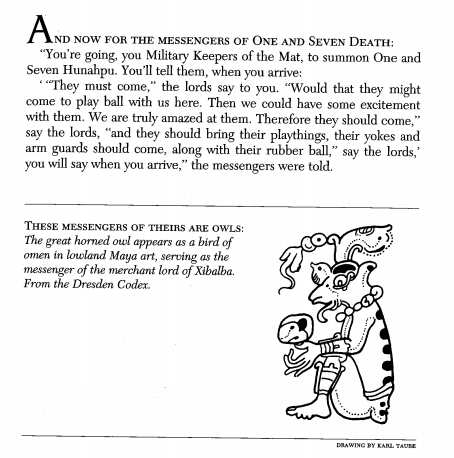
There are several translations available in English. Here is the passage with which this Alcheringa selection begins, as translated by Dennis Tedlock in 1996:
David Damrosch provide a useful, contextualizing overview of creation narrative (see Popol Vuh Experts View below):
“One of the great questions taken up by the world’s creation myths is how and why people came to be. Granting (as many traditions have done) that the world was created by all-powerful gods and goddesses, just what did they need people for? The Babylonians and the ancient Greeks agreed that we were put on Earth to serve the gods, offering them pleasing sacrifices. In the Bible, Adam and Eve are assigned the task of gardeners, tending God’s creation. Popol Vuh’s account of the creation of humans is comparable to these other stories, but with a distinctive emphasis on speech and memory. The gods don’t appear to want food offerings or any practical kind of service: they want to be praised, and they are disappointed by the wooden people because the wooden people lack feelings and can’t remember them. The story of creation is thus infused with the book’s pervasive concern with the fragility of memory. It highlights the quintessential human capacity to preserve memory through language, so that people can honor their creators—both the divine creators of the universe and also the human ancestors and the native culture whose memory Popol Vuh seeks to preserve “amid the preaching of God, in Christendom now.”
Bibliography
Edmonson, Munro. The Book of the Counsel: The Popol Vuh of the Quiche Maya of Guatemala. Middle American Research Institute, Publication 35, Tulane University, New Orleans, 1971.
American Historical Society. Popol Vuh. https://www.historians.org/teaching-and-learning/teaching-resources-for-historians/teaching-and-learning-in-the-digital-age/creation-stories-and-epics/popol-vuh (A brief overview of the context of this text, with discussion questions for students).
Tedlock, Dennis. The Popol Vuh: The Mayan Book on the Dawn of Life. (revised). Simon and Shuster, 1996. (A full, English translation that aims to be readable and accessible; significant scholarly detail is contained in lengthy endnotes).
Tedlock, Barbara and Dennis Tedlock. Breaking the Maya Code. Transcript of film interview. Night Fire Films. 2005. https://nightfirefilms.org/breakingthemayacode/interviews/TedlocksTRANSCRIPT.pdf
Popol Vuh: Experts View. Invitation to World Literature. Annenberg Learner. https://www.learner.org/series/invitation-to-world-literature/popol-vuh/popol-vuh-experts-view/
Metadata
Topics
Initial author: Ken Sherwood


