This is an old revision of the document!
Table of Contents
Black Majesty
Author: Luis Palés Matos (1898 - 1959) From: Puerto Rico Translated from Spanish by: Paquito D’Rivera
Palés Matos's Black Poetry
He explored the theme of negrismo (negritude) in the context of Puerto Rico’s conflictive relation to its own Afro-Antillean roots, taking an ambivalent stance. His collection of poems Tuntún de pasa y grifería (1937) is considered one of the classic foundational texts of Afro-Caribbean poetry in Spanish, with the Haitian Revolution showing up in several of the poems. The book has encountered conflictive readings throughout the years. He has been criticised for being a white poet offering a stereotypical representation of blacks in the Caribbean, reducing them to sexualized, exotic dancing figures. On the other hand, he has been celebrated for defending Puerto Rico's national identity as a heterogeneous mixture of culture and peoples, in his ambiguously ironic use of words and elements that characterize the islands.
Key Words/Terms
- Antillean - Antilles is an archipelago in the Caribbean.
- Tembandumba of the Quimbamba - The Grand Matriarch of the region of Puerto Rico, Cuba, and Santo Domingo.
- Rumba - a rhythmic dance
- Macumba - a folk religion that includes rituals and dances.
- Candombe - a style of music and dance from Uruguay originated among African slaves.
- Bámbula - in kikongo: meaning “to remember” or “to re-remember”; also “bambulé”: meaning an African dance.
- Gongos and maracas - musical instruments.
- Steatopygous - big butt / In Puerto Rico: “Culipandeando”, meaning rythmically moving one's butt when walking.
- Flower of Tórtola - white cedar flower, the territorial flower of The Virgin Islands.
- Bombas and bambulas - percussion instruments.
- Ñáñiga blood - from the Cuban Abakuá society.
- Melao, melamba - Refers to thick molasses in Puerto Rico. In colloquial language, it is used to express admiration.
Poem's Meaning
This poem was written with the sole purpose of bringing attention to the beauty of the Black women that were considered Queens of the Caribbean. Following along with the poem itself it depicts a woman dancing in the streets to the music around her, sensualizing and sexualizing the act of the woman dancing; the author near the end of the poem gives in to the way the dance makes him feel.
It seems that when this poem was performed it was accompanied by music and dance while being read, like in this version in Spanish.
Untranslated Text
Majestad Negra, por Luis Palés Matos
Por la encendida calle antillana
va Tembandumba de la Quimbamba
—rumba, macumba, candombe, bámbula—
entre dos filas de negras caras.
Ante ella un congo—gongo y maraca—
ritma una conga bomba que bamba.
Culipandeando la reina avanza
y de su inmensa grupa resbalan
meneos cachondos que el gongo cuaja
en ríos de azúcar y de melaza.
Prieto trapiche de sensual zafra,
el caderamen, masa con masa,
exprime ritmos, suda que sangra,
y la molienda culmina en danza.
Por la encendida calle antillana
va Tembandumba de la Quimbamba.
Flor de Tórtola, rosa de Uganda,
por ti crepitan bombas y bámbulas;
por ti en calendas desenfrenadas
quema la Antilla su sangre ñáñiga.
Haití te ofrece sus calabazas;
fogosos rones te da Jamaica;
Cuba te dice: ¡dale, mulata!
Y Puerto Rico: ¡melao, melamba!
¡Sus, mis cocolos de negras caras!
Tronad, tambores; vibrad, maracas.
Por la encendida calle antillana
—rumba, macumba, candombe, bámbula—
va Tembandumba de la Quimbamba.
Black Majesty in different media
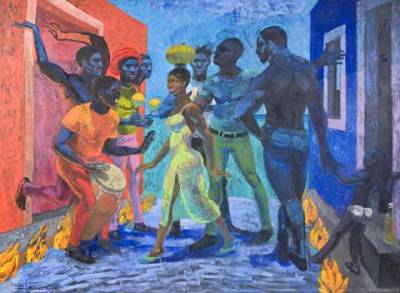
Matos' poem has also influenced other artists from different categories. For instance, Puerto Rican painter and sculptor Carlos Cancio, who sought to represent the Afro-Antillano beauty in his 2003 painting called “Por la encendida calle Antillana va Tembandumba de la Quimbamba”, exhibited at the Museo de Arte de Puerto Rico. Matos' Black Majesty inspired music artists to perform his poem in various styles, like this 2019 version by the People of Earth project (watch video here).
Figure 1: Cancio “Por la encendida calle Antillana va Tembandumba de la Quimbamba” (2003)


