This is an old revision of the document!
Table of Contents
Oswald de Andrade Biography
//
//
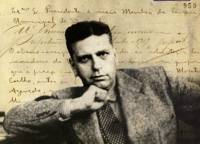 Jose Oswald de Sousa de Andrade was born in São Paulo on January 11, 1890. He was a Brazilian poet, novelist, playwright, and journalist, known as one of the founders of modernism in Brazil. When young, he had the opportunity to travel to Europe, which allowed him to be in touch with the European avant-garde of the beginning of the 20th century, assimilating into his work several of the trending innovations in the European art world and bringing new cultural horizons to Brazil.
Famous for being ironic, provocative, and a political activist, Andrade was the author of the most important manifestos: the Brazilwood manifesto and the Antropofaghic manifesto. His name is directly related to the organization of the 1922 Modern Art Week, the reformulation of what was considered art and literature in Brazil, and the strengthening of national intellectuality. His work presented a nationalism that seeks its origins and historical-cultural past in a critical way, parodying and ironizing the history of colonization. Andrade was in defense of another literary language, focused on oral tradition, whose speaker is not the erudite writer but the common population, the common Brazilian. This other language represents another being, which is the national man.
In 1926, he married Tarsila do Amaral, who did the illustrations for his first book of poems, “Pau-Brasil.”. Together, they founded the Anthropophagic Movement, where they propose, in literature and painting, that Brazil should devour foreign culture and create its own revolutionary culture.
After a long illness, Oswald died in São Paulo, on October 22, 1954, at the age of 64.
Major Themes
- Oswald de Andrade is calling back to a primitive state of artwork in Brazil that is natural and does not rely heavily on unnecessary inventions. A technique he uses to establish this theme is the symbolism of nature. Andrade references poetry being hidden “in the malicious vines of learning. In the lianas of academic knowledge” (149). The elements of nature, which are out of control in this quote, seem to represent the idea of Brazilian poetry being restricted by Portuguese influence (151). There is a call made to return to true Brazilian poetry, which is viewed as being sincere and straightforward, similar to how a child states their opinion without any worry of what the next person will think (149).
- Andrade also establishes a theme of the true beauty of Brazil being found in the authenticity of its natural surroundings. The first few lines of the poem state, “The shacks of saffron and ochre in the green of the Favela, under cabralin blue are aesthetic facts” (149). Favela is a term that refers to several poor neighborhoods in Brazil, often called “slums.” However, instead of being surrounded by negative adjectives, the Favela is described as including the aesthetic colors of blue and green, which are often found in natural settings. Ownership of places in Brazil, like the Favela, are later expressed in the poem with the phrase “Barborous [cruel and brutal] and ours,” showing a sense of pride for Brazilian culture.

Tarsila do Amaral - Morro da Favela (1924) (Favela portrayed as described in Andrade's manifesto)
Context: Portuguese Colonization of Brazil
In early 1500, a Portuguese explorer named Pedro Álvares Cabral set sail for India but, instead, landed in Brazil. After landing, Cabral and his men found value in the goods of Brazil, including locations to produce sugar and red dye. Their interest led to a system of slavery, involving both Natives of Brazil and imported slaves from Africa. Due to this form of control, Brazilian culture was heavily impacted. Andrade references the importance of these lasting effects in his manifesto, which was written a century after Brazil gained its independence. In the full version of his manifesto, Andrade proposes “the counter-weight of native originality to neutralize academic conformity,” displaying a push back against complying with standards put in place outside of true Brazilian culture (187).
Context: Brazilwood
Brazilwood, also known as Paubrasilia echinata, is the national tree of Brazil. It was vastly recognized for the red dye that it produced and was one of the main exports from Brazil throughout the sixteenth century. Similar to the exportation of Brazilwood, Andrade calls for an exportation of Brazilian poetry in his manifesto to display authentic Brazilian culture. The choice of “Brazilwood Poetry Manifesto” as a title enforces the message Andrade presents in this poem on the importance on Brazilian artwork going back to its roots.
Connection to the concept of "transcreation"
// // When Oswald de Andrade defended in the Anthropophagic Manifesto the focus on the consumption of his own culture, he did not close the doors to foreign literature. However, the process of translating any text should seek to get closer to the culture of the target language while still respecting its original one. Alongside that, the Brazilwood Manifesto encourages the exportation of the country art, considering the adaptations the target language may require to comprise the author’s ideas. Haroldo de Campos, whose word transcreation was coined, emphasized that translation is much more than moving text from one language to another. Elements of the structure of the poem, like rhythm and sound combinations (rhyme, echoes, assonance, etc.), are often more important than semantics per se. When asked by Nobrega and Giani if the transcreated text would be a new text made from the original one,Paes stated that “it is new within that language, but it is not new because it is a version, a translation of a pre-existing text. But in any case, it can be read as complementary text to the original. To the point where you can imagine the text not just as one written in the original language, but as the sum of the original plus all its translations” (134)[1]. The author used the metaphor of a ray of light through a series of prisms and the Bible and its multiple translations as examples of the transcreation process.
[1] Translated from the Portuguese interview.
References
Andrade, Oswald, et al. “Manifesto of Pau-Brasil Poetry.” Latin American Literary Review, vol. 14, no. 27, 1986, pp. 184–187, https://www.csus.edu/indiv/o/obriene/art109/readings/andrade%20manifesto%20of%20pau-brasil%20poetry.pdf. Accessed 12 Feb. 2025.
“Anthropophagic Movement.” Wikipedia, https://en.wikipedia.org/wiki/Anthropophagic_movement. Accessed 12 Feb. 2025.
“Brazil: Five Centuries of Change.” Brazil Five Centuries of Change, https://library.brown.edu/create/fivecenturiesofchange/. Accessed 12 Feb. 2025.
“Manifesto Pau-Brasil.” Wikipedia, https://en.wikipedia.org/wiki/Manifesto_Pau-Brasil. Accessed 12 Feb. 2025.
“Morro Da Favela (1924) by Tarsila Do Amaral.” Artchive.com, 19 Nov. 2024, https://www.artchive.com/artwork/morro-da-favela-tarsila-do-amaral-1924/. Accessed 12 Feb. 2025.
Nóbrega, T. M., & Giani, G. M. G. (2012). “Haroldo de Campos, José Paulo Paes e Paulo Vizioli falam sobre Tradução”. Trabalhos em Linguística Aplicada, 11(1). https://periodicos.sbu.unicamp.br/ojs/index.php/tla/article/view/8639057. Accessed 12 Feb. 2025.
“Oswald de Andrade.” Wikipedia, https://en.wikipedia.org/wiki/Oswald_de_Andrade. Accessed 12 Feb. 2025.
“Paubrasilia.” Wikipedia, https://en.wikipedia.org/wiki/Paubrasilia. Accessed 12 Feb. 2025.
“Pedro Álvares Cabral.” Wikipedia, https://en.wikipedia.org/wiki/Pedro_%C3%81lvares_Cabral. Accessed 12 Feb. 2025.
“Portuguese Colonization - Brazil.” OER Commons, https://oercommons.org/courseware/lesson/87885/student/310630?section=2. Accessed 12 Feb. 2025.
“Tarsila Do Amaral.” Wikipedia, https://en.wikipedia.org/wiki/Tarsila_do_Amaral. Accessed 12 Feb. 2025.


