This is an old revision of the document!
Table of Contents
Lady Be Good - Ella Fitzgerald
from Lady Be Good (Serpent 549-550)
Ella Fitzgerald (1917–1996), known as the “First Lady of Song,” was a famous American jazz singer. She had a beautiful, clear voice and was especially good at scat singing, which is a way of singing using sounds and syllables instead of real words. She became well known in the 1930s when she sang with the Chick Webb Orchestra, and later became one of the most important voices in jazz. Her singing combined strong musical skill with real emotion and feeling.
Ella was one of the first singers to make scat singing popular. She made it more creative and expressive by using different rhythms and sounds in a very unique way. During her long career, she worked with many other jazz stars, such as Louis Armstrong, Duke Ellington, and Count Basie.
Her 1947 performance of “Lady Be Good” with the Bob Haggart Orchestra is one of her most famous. In this recording, her voice becomes like a jazz instrument, creating music on the spot. This performance is often seen as a key moment in the history of jazz singing.
Ella Fitzgerald’s music still inspires singers today. Her scat solos, like the one in Lady Be Good, show how the human voice can be used not just to sing words, but to make music full of rhythm, creativity, and emotion. You can hear her 1947 performance on YouTube Fitzgerald, 1947.
About the Text
The anthology includes the transcribed scat “syllables” sung by Ella Fitzgerald in the 1947 recording of “Lady Be Good” with the Bob Haggart Orchestra. The song includes conventional, poetic lyrics lyric genius sung conventionally by many vocalists.
About Scat
Following the conventions of jazz musicians taking improvised solos, Ella Fitzgerald developed (pioneered?) the practice of jazz vocalists also improvising melodic and rhythmic solos, rather than singing the lyrics only and allowing instrumentalists to take improvised solos. Voice always involves syllable sounds. Hum a tune … “la la la la la”. Fitzgerald is notable for the skill, variety and individuality she brings to all dimensions of these solos.
In the _Serpent and the Fire_, the patterns of scat syllables are foregrounded – showing their variety, permutations and rhythms.
===== Lady Be Good =====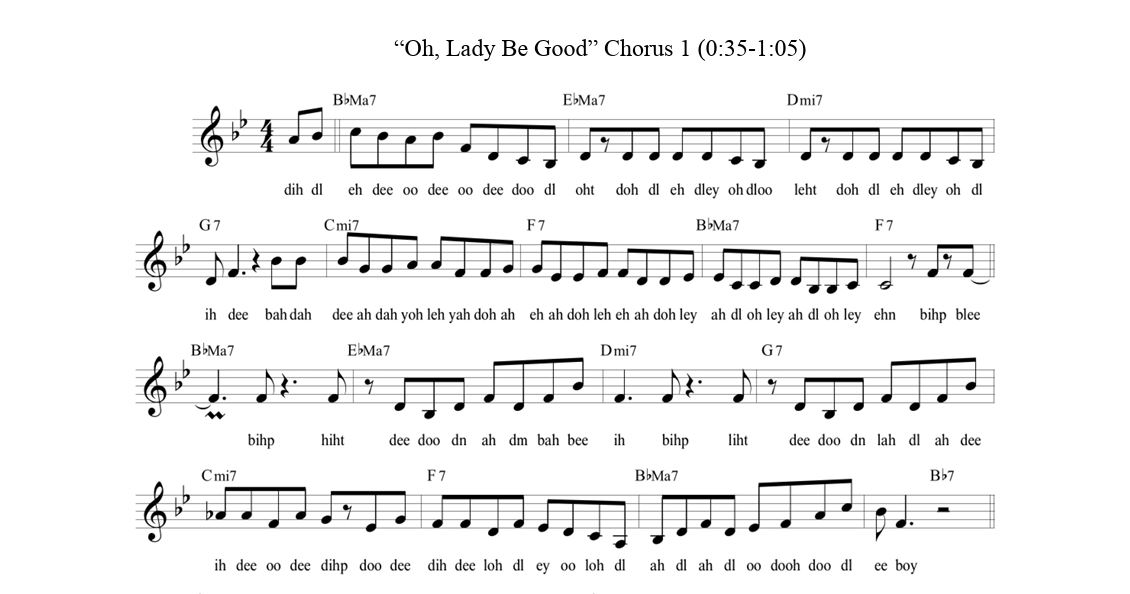
The transcription anthologized reflects a particular performance:
Youtube of 1947 recording - solo begins at 0:36
It is a representation of the musical transcription from Justin Garrett Binek's academic study “Ella Fitzgerald: syllabic choice in scat singing and her timbral syllabic development between 1944 and 1947” (page 23) PDF. This study looks at the evolution of Fitzgerald's style and notes this performance of this tune as a turning point.
Improvisation invovles varying degrees of inventiveness or composition through performance. It should be noted, then, that the text above was not not composed, written, or planned in any usual sense prior to the performance.
For implicit evidence of this, note other available recordings of Ella Fitzgerald peforming “Lady Be Good” with very different scat solos:
- Lady Be Good, Nobody's Fool, Chicago 1981 begins at 3:45


