This is an old revision of the document!
Table of Contents
The Meaning of Meaningless Words and the Coefficient of Weirdness
Bronislaw Malinowski
(b. 1884–d. 1942)
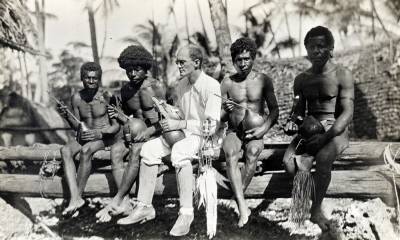
Polish anthropologist and ethnologist. Malinoski was heavily influential in challenging the evolutionary paradigm of his predecessors and introducing the theory of functionalism, which argues that institutions satisfy human biological needs as a way to understand other cultures (Holdsworth). Part of what set Malinowski apart was that instead of observing a culture or society, he redefined “fieldwork” when his first attempts to study people failed. Disheartened by the setback, Malinowski resolved to try again, this time with the Trobriand Islands off the northeast coast of New Guinea. Immersed in the Trobriand culture and language, Malinowski's writings and ethnographies of the people redefined how “civilized” society might have viewed them from the outside: these were a people with a complex structure of governing and a language to boot- which is where “The Meaning of Meaningless Words and the Coefficient of Weirdness” comes into play. Overall, according to Chris Holdsworth, “Malinowski tackled some of the most important and controversial topics of his day: economics, religion, family, sex, psychology, colonialism, and war. He insisted that a proper understanding of culture required viewing these various aspects in context.” It is through the combination of these elements of society that we begin to understand people because these are the concerns of humans.
Trobriand Language
It should be noted that Malinowski argued that language was not simply for communication. Malinowski argues that language is needed to create social bonds and to continue a culture and way of life. As such, Malinowski's writings on the Tobriand language examine the concept of magic and ritual because its speakers believe in the mysticism of their language.
The Trobriand language is called Kilivila (or Kiriwina). The speakers of Kilivila believe that magic is deeply tied to the language with specific words or phrases in particular contexts like harvest, fertility, and wellbeing. In other words, Kilivila speakers believe in the power of magic that resides within the words themselves when spoken correctly in specific contexts.
Weirdness and Language
What makes a word powerful? What is the purpose of reciting words alone to generate an outcome?
According to “The Meaning of Meaningless Words and the Coefficient of Weirdness,” “The wording of magic is correlated with a very complicated dogmatic system, with theories about the primeval mystical power of words, about mythological influences, about the faint co-operation of ancestral spirits, and, much more important, about the sympathetic influence of animals, plants, natural forces, and objects” (Malinowski 112). Essentially, there is a formula and reasoning behind these chants- and while we don't quite subscribe to magic words, we still argue for the idea of voicing something to the universe.
The Power of Strange Words in Culture
Malinowski explains that some words are special because they are different from normal speech. The coefficient of weirdness means that when words sound unusual and are used in rituals, people believe they have a special power. These words do not just carry meaning; they also create a sense of mystery and importance.
In many cultures, powerful words are not always easy to understand. Religious prayers, magic spells, and even legal or political language often use words that feel complex or secret. This makes the words seem more important because only certain people know how to use them. Malinowski’s idea shows that language is not only for communication—it can also influence, connect, and control people in unique ways.
Works Cited
Holdsworth, Chris. “Bronislaw Malinowski.” Oxford Bibliographies, 31 July 2019, https://www.oxfordbibliographies.com/display/document/obo-9780199766567/obo-9780199766567-0096.xml.


