This is an old revision of the document!
Table of Contents
Exploration of Authorship in Nahuatl Poetry
By using the Cantares Mexicanos as a test case, we are going to explore the concept of authorship in Nahuatl poetry starting with John Bierhorst's Cantares Mexicanos The Songs of the Aztecs, following up with León-Portilla's contrasting opinions in Fifteen Poets of the Aztec World, and concluding by utilizing Jongsoo Lee's, “Nezahualcoyotl and the Notion of Individual Authorship in Nahuatl Poetry,” to further understand the division in perspectives and information.
Background
In The Serpent and The Fire, “A Paradise of Poets,” transcreated by Javier Taboada, is presented as a 1460's meeting between poets organized by the ruler and poet, Tecayehuatzin, “The result of that historical meeting, as it comes to us, was a long renga-like poem that works as a collection of brief personal manifestos, the specific poetics through which the participating singers, whose names are given in brackets, developed their work or found meaning in it” (Rothenberg and Taboada 28). The reader is then pointed towards Cantares Mexicanos collected & translated into Spanish by Fray Bernardino de Sahagún.
 In 1985, John Bierhorst translated the entire Cantares Mexicanos codex into English for the first time. In the introduction to Bierhorst's Cantares Mexicanos Songs of the Aztecs, he argues that Cantares Mexicanos was a part of the post-conquest revitalization movement, the poems function as “Ghost Songs,” and there is no evidence of king/poets/identifiable authors of the Cantares.
Bierhorst is called out directly by Miguel León-Portilla in the introduction to Fifteen Poets of the Aztec World, “…a hypothesis has been presented that simply dismisses the possibility of establishing any author relationship in the ensemble of the Nahuatl songs and poems, which are generally accepted as part of the ancient indigenous tradition. The author of the hypothesis claims that those compositions were done in the Colonial days with the specific purpose of being entoned as 'Ghost Songs' in rituals similar to those performed by some contemporary North American Indian groups. It is obvious that such a hypothesis, if valid, would contradict almost everything that is expressed in this book…”(León-Portilla 42). 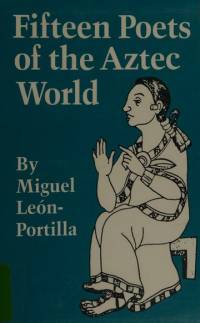
These contradicting viewpoints lead to two different approaches to Cantares, and it complicates the reading of the transcreated poem in SaF. Jongsoo Lee's, “Nezahualcoyotl and the Notion of Individual Authorship in Nahuatl Poetry,” highlights the concept of individual authorship in Cantares as a European distortion of indigenous cultural tradition, “The notion of individual authorship in Nahuatl song-poetry, known as in xochitl in cuicatl ('flower and song'), constitutes a clear example of this phenomenon” (Lee 73).
By exploring these perspectives, the goal is to gain a clearer understanding of Nahuatl poetry and the idea of authorship within Cantares Mexicanos and in other Nahuatl poetry.
Bierhorst's Claims in Cantares Mexicanos
Overview
- Date of Songs
- All post-conquest, except potentially 54-E, and related 54-A, 54-B, 54-C, & 54-D.
- Authorship of Songs
- Not likely to have been composed by any of the kings mentioned, “I am…” formula is used to invoke, not as a way to attribute
- The Classification of Ghost Songs & Ghost Song Vocabulary
- Flowers and songs are persons/spirits descending from the sky, brought to life through the singer and gods
Dating the Songs
Bierhorst begins by dating based on scribes, “As a first step towards dating the manuscript, it should be noted that the entire book, with the exception of a few pages, is in a single hand, more fluent in the Spanish than in the Nahuatl, usually meticulous, sometimes hasty, but invariably Italian and distinguished by numerous peculiarities. Although several scribes may have been involved, the overall uniformity suggests a single project in a single setting. I will refer to this script as hand A. And since the Prologue to the Arte divinatoria (old folio 292, hand A) mentions 'este [año] de 1585,' the book as a whole must be dated no earlier…Thus the early or mid-1590's would appear to be the most likely time for the labors of the hand-A scribe, or scribes, whose gracefully executed copies were finally assembled, perhaps, in 1597” (Bierhorst 8).
Bierhorst continues to say that the songs were taken from native informants during the 1550s-70's with a couple songs as late as the 1580's. He believes that some were collected singley, while others were collected in batches by an acculturated Indian, most likely under the direction and in service of Sahagún, “…we may note the obsequious tone and the grammatical error (ellas for ellos), and infer that the writer is a bilingual Indian in the service of a white master” (9).
He ends the section on “Errors of the Cantares Glossator” by saying that everything outside of the song texts should be taken with a grain of salt. (14). This is where the biggest conflict in dating and attributing authorship arises between Bierhorst and León-Portilla. León-Portilla uses a combination of the glosses, commentary, songs, and historical information to place specific authorship with some songs.
More conclusively, Bierhorst writes, “There is no way to be sure that any song in the Cantares is an unadulterated pre-Conquest composition. Yet the obvious borrowing of phraseology from the Anales de Tlatelolco, as noted in Chapter Nine, suggest that at least one piece, song 54-E, has a pre-Conquest origin” (109). He places similar pieces like song 54-A, B, C, and D, tentatively in the same category as 54-E.
Authorship of Songs
When discussing authorship of the songs, Bierhorst begins by discussing the “I am…” formula as a way to identify with super natural power or to invoke spirits, “Occasionally the singer will say 'I am tonoquihuaztli' or 'I am Nezahualcoyotl'… in which case he speaks with the voice of the king named, either recognizing the king's spirit as his muse or merely filling in a needed portion of the dramatic monologue… This seems entirely clear; yet it needs emphasizing, since the 'I am' formula is presumably the source of one of the most hallowed-and most destructive-misconceptions about Aztec poetry. The notion that surviving ghost songs were composed by great kings can be traced to Ixtlilxochiyl and his circle, which implies a date of approximately 1600…” (Bierhorst 101).
Bierhorst uses this “I am…” formula, along with invocations in second and third person to argue that these songs are unlikely to have been composed by any of the kings that are named (104).
Classification of Ghost Songs
Bierhorst believes that from the material it should be clear that flowers or songs are people, as is supported by Aztec thought, “When the ghost singer says he is uttering, or bringing down, “songs” he usually means that he is producing ghost warriors.” In the section, Reciprocity., he adds, “Song making is an act of cooperation between the mortal singer and his other-wordly source. The singer 'begins,' or 'strikes up,' the song, but the heavens must give the 'answer,' or the 'echo.' The singer 'lifts up' songs, but the songs themselves descend from the sky…” (18-19).
He further expands in the section, Songs as a distribution of Life Giver, “The personified songs are actually a parceling out, or distribution, of the supreme spirit…the ghost warriors are brought to earth by an act of remembrance… To sing a dead warrior's praises is to do more than perpetuate his memory-it is literally to bring his spirit to earth… Often the ghost warrior will be identified both as an ancestor and as a manifestation of Life Giver, all in the same stanza: 'flowers have arrived. He's here: it's God Life Giver. Ah, I weep, recalling Nezhualcoyotl' (song 46, stanza 7). And just as the singer is said to be 'pleasuring' the ghosts, in many cases he explains that he is pleasuring, or 'entertaining,' Life Giver” (Bierhorst 18-26).
“The singer who produces ghost warriors is conscious that his creations are merely borrowed from the other world…Already on the warpath, the 'flowers' will be returning to paradise after what seems to be no more than a moment on earth (song 30)” (48).
Ghost Song Vocabulary
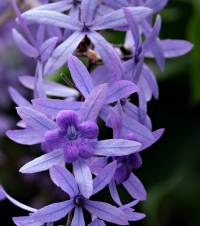 The concept of the sacred drum is important for the reading of SaF from this perspective, “Stationed beside the drum, the ghost singer reshapes the world around him and envisions the world beyond. The latter, seen only in the mind's eye, may be referred to as:
- heaven, ilhuicatlitic
- place of good song, yectli cuicatlan
- land of flowers, xochitlalpan
- land of plenty, tonacatlalpan
- Life Giver's home, ichan Ipalnemohuani…
As ghost arrive from the other world, the place beside the drum becomes a replica of paradise… Names applied especially to the dance floor include: 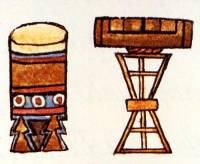
- beside the drum, huehuetitlan
- place of song, cuicatlan
- flower mat, xochipetlatl
- flower house, xochicalli” (Bierhorst 35-41).
Revitalization
Bierhorst places the Cantares Mexicanos, as mostly post-conquest and as a part of the revitalization, “For our purposes, revitalization may be defined as the process wherein a culture in danger of being supplanted asserts itself in a modified form, challenging its oppressor insofar as it dares.”
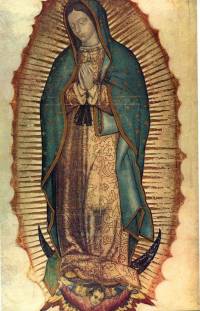 “It is not certain that any of it was composed before the Conquest, and it is most likely indeed that it is political in conenct even where it least appears so…Many ghost songs, in other words, are passively subversive. They merely predict a state of bliss without alluding to the culprits or injustices. In many of these, if not most, the supreme spirit is identified with the Christian Dios; and in a few there are outward signs of accommodation, not only with Christian doctrine, but with Hispanic authority” (63).
León-Portilla's Claims in Fifteen Poets of the Aztec World
Overview
- Date of Songs
- Passed down through oral tradition, importance of the huehuehtlahtolli, “ancient word” - ability to trace back through time.
- Authorship of Songs
- While most of the songs are anonymous, León-Portilla utilizes the triple procedure to identify the fifteen authors. Within this are the poets who attended the meeting organized by Tecayehuatzin about flowers and songs.
- The Classification of Ghost Songs & Ghost Song Vocabulary
- Bierhorst utilizes his own translations to support his “Ghost Dance Ritual” interpretation, which creates circularity between the evidence and translation (43-44).
- “Bierhorst's 'no more than a theory' that led him to reject as false the indigenous testimonies that attribute specific songs to specific indigenous composers from the fourteenth and fifteenth centuries has been the cause of his many deviations, not to say errors, as translator… To simply reject the textual attributions on the basis of his 'no more than a theory' and to claim in addition the undocumented (and actually nonesisting nativistic movement is unacceptable from a historical and critical perspective” (León-Portilla 44).
Dating the Songs
León-Portilla utilizes internal and external evidence as well as historical records to determine the dates of the Cantares Mexicanos “The dates registered in the longer part (fol. I r. -79 v.) are mainly if not totally related to the substantial number of songs of clearly Euro-Christian inspiration included in the collection,” (27), he adds that fol. 42 v. states that it was entoned in 1536, and fol. 43 r. was composed when the Aztec were conquered in 1520 to 1521.
In addition, the other dates that are recorded from 1550 to 1565, which allowed Sahagún to have time to prepare his Psalmodia, which was published in 1583. Also, fol. 80 r. -85 r., he attributes to a predicted misrendering of 1597.
León-Portilla describes the process for dating and attributing authorship, “Parallel to the references attributing a song to a Christianized native, other indicate that such songs not only had an origin antedating the Conquest but were also the fruit of a particular person's inventions. The reliability of these reference obviously depends on the possibility of making two crucial assertions. One is the existence of songs with a genuine pre-Hispanic origin that may have been brought down to us. The other possibility of linking one or more of those songs with the name of a composer about whom something can be said. The meaning and validity of the present book depends on the critical evaluation of the references to the origins and authors of the songs presented as pre-Hispanic will take into account the internal evidence provided by the manuscripts of the Cantares Mexicanos and the Romances, which will be described, and also the external evidence that can be found in other independent sources” (29-30).
Authorship of Songs
On the process of determining the authorship of song, León-Portilla uses a triple procedure to discern the reliability and attributions to specific authors, “The first has to do with the person to whom the song is attributed. One has to find in other independent testimonies reliable information about his or her existence. Related to this is the possibility of adducing testimonies asserting the fame of the same individual as a composter of songs. The third procedure is a search for eventual independent renditions of one or more of the songs attributed to the same person” (34). Through this process, León-Portilla identified 15 poets or song composers. For our purposes, we are focusing on Tecayehuatzin, Ayocuan, Aquiahuatzin, Cuauhtencoztli, Motenehuatzin, and Tlapalteuccitzin, the authors who are a part of the transcreated SaF, “Paradise of Poets,” as well as Nezahualcoyotl, arguably one of the most well-known Nahuatl Poet/King.
Comparison between SaF and Fifteen Poets of the Aztec World
|
[Tecayehuatzin:] Where have you been, O composter of songs? Make ready the flowery drum that is wreathed with quetzal feathers, intertwined with golden flowers. You will delight the nobles, the eagle warriors and the jaguar warriors. Surely he went down to the place of the kettledrums, surely the poet is there, unfolding his precious songs, offering them, one by one, to the Giver of Life. The little-bell bird responds to Him. It sings, it offers flowers, it offers our flowers. I hear its voices there, truly it answers to the Give of Life, the little-bell bird responds, it sings, it offers flowers, Your words rain down like jades and precious feathers! Ayocuan Cuetzpaltzin also speaks in this way, surely he knows the Giver of Life. That famous lord also comes here to speak in this way, the lord who delights the one God, with bracelets of quetzal feathers and with perfumes. Might it not be pleasing to the Giver of Life? Might it not be the only true thing on earth? For a brief moment, for the time being, I have borrowed the princes: bracelets, precious stones, I surround the nobles only with flowers. I bring them together with my songs in the place of the kettledrums. I have called this meeting here in Huexotzinco. I, Lord Tecayehuatzin, have brought the princes together: precious stones, quetzal feathers (211-12). |
[Tecayehuatzin:] Where do you dwell, poet? It is true he has just descended to the stage of sacred drums That's the life of the poet: to unfetter like the quetzal's feathers to spread out the Life-Giver's songs. For within Heaven from there delightful flowers delightful songs come. Our desire deforms them. Invention spoils them (25). |
|
[Cuauhtencoztli:] I, Cuauhtencoztli, am suffering here: Does man have any roots? If not, our song will no longer be true. What stands and remains? What reaches its aim? Here we life, here we are, but we are impoverished, o my friends. |
[Cuauhtencoztli:] Are men true? If they are not our song will not be truth. |
|
[Motenehuatzin:] I have come here only to sing. What are you saying, O my friends? What are you discussing here? O Princes, here is the flowery patio. (“Nevertheless, Motenehuatzin has to acknowledge that, even 'in the midst of spring,' singing is often accompanied by weeping:”) The truth is we scarcely live, for we are enbittered by sorrow… Dissimilar flowers, dissimilar songs, in my house all is affliction (204-205). |
[Motenehuatzin:] I just came here to sing sad flowers sad songs. All turns into hate here. We live in the House of Spring sad flowers sad songs. All turns into hate here. |
Genre in Nahuatl Poetry & "Ghost Songs"
“…a hypothesis has been presented that simply dismisses the possibility of establishing any author relationship in the ensemble of the Nahuatl songs and poems which are generally accepted as part of the ancient indigenous tradition. The author of the hypothesis claims that those compositions were done in the Colonial days with the specific purpose of being entones as 'Ghost Songs' in rituals similar to those performed by some contemporary North American Indian Groups… Such contributions would be extremely welcome, were it not for Bierhorst's unexpected assertion that all these songs are 'ghost songs,'
In contrast to the singular reading of Cantares Mexicanos soley through the lens of “Ghost Songs,” León-Portilla offers other genres, “These are the genres that both the Cantares and the Matritense register: xopancuicatl (songs of springtime), Xochicuicatl (flowery songs), totocuicatl (songs of birds), michcuicatl (songs of fish), icnocuicatl (songs of orphanhood), cozcacuicatl (necklace songs), teuccuicatl (songs of the lords), tlaocolcuicatl (songs of suffering), cuauhcuicatl (songs of eagles), yaocuicatl (songs of war), atequilizcuicatl (songs of pouring water), cihuacuicatl (songs of women), cococuicatl (songs of doves), cuecuechcuicatl (provocative songs), and huehuehcuicatl (old songs, or songs of old people)…” (28).
Jongsoo Lee's "Nezahualcoyotl and the Notion of Individual Authorship in Nahuatl Poetry"
As the Aztecs were transition from their pictorial and oral tradition to the European alphabetic writing system in colonial mexico, many indigenous artistic representations that lost their unique contents and forms due to the distortion of the European/Europeanized chroniclers as they were interpreting indigenous cultural transitions from a colonizer's perspective, “The notion of individual authorship in Nahuatl song-poetry, known as in xochitl in cuicatl (“flowers and songs”), constitutes a clear example of this phenomenon” (Lee 73).
Bierhorst vs. León-Portilla
In the notes, Lee further expands on the conflict between the two schools of thought, as discussed earlier with the exploration of Bierhort and León-Portilla, “Garibay and León-Portilla argue that most of the songs collected in Romances and Cantares were composed during pre-Hispanic times. This view was challenged by John Bierhorst who argues that most of the songs originated in the mid-sixteenth century during an attempt to reinterpret and revitalize the indigenous past…” (84).
Notion of Authorship in Nahuatl Poetry
The notion of individual authorship, in Lee's opinion, is a construct of distorted Europeanized chroniclers. Lee begins by looking at the first attempts to assign individual authorship in Nahuatl poetry, which he identifies as the sixteenth century Texcocan chroniclers, like Juan Bautista Pomar, Alva Ixtlilxochitl, and Spanish priest Juan Torquemada,
“They commonly include some fragmented poems in their chronicles that they attribute to Nezahualcoyotl. Pomar records that Nezahualcoyotl was a sage and philosopher king who was very skeptical about the indigenous religions that required human sacrifice… Later historians and literary critics such as William H. Prescott in the nineteenth century, and Francis Gilmor, Angel María Garibay, Miguel León-Portilla, and Birgitta Leander in the twentieth century emphasize this peaceful image of Nezahualcoyotl in contrast ot he dominant militaristic culture of the Aztecs… It was Angel María Garibay who reinforced and confirmed the idea of Nezahualcoyotl as a poet in the 1960's…Just like Ixtilxochitl, Garibay accepts Nezahualcoyotl's authorship by simply arguing that 'cuando leemos: Yo soy Tecayehuatzin, no tenemos motivo para negarlo. Y tampoco, acaso menos, cuando leemos: Yo soy Nezahualcoyotl, soy el poeta de gran cabeza de loro (5, 1)' (Poesía Nahuatl 1: XXXIX). In this way, he was able to identify many other poets before the conquest… Following Garibay's lead, Miguel León-Porfilla confirms the posited individual authorship by following three steps…” (Lee 73-5)
He later specifically calls out León-Portilla and Garibay for their use of the Texocan chroniclers, “Garibay and León-Portilla seem to be successful in establishing the authorship of these Nahuatl poems, but they do so by basing their arguments on the chronicles of Pomar and Ixtlilxochitl, by faithfully following glossator's notes within the song texts, and by stuyding the lives of the poets” (75).
Following their lead, there are many other scholars who have studied individual Nahuatl poets, and Nezahualcoyotl has been the most popular (75). Interestingly, a new book on Nezahualcoyotl's poetry, Lamentations of Nezahualcóyotl: Nahuatl Poems by Ilan Stavans will be published on May 8, 2025.
Along with other Nahuatl scholars such as John Bierhorst, Richard haly, James Lockhard, Frances Karttunen, and Gordon Brotherston, Lee argues that searching for and detecting authorship is a European preoccupation, “Nahuatl song-poems are quite different from the European poetic tradition in terms of structure and performance: European poems were individual author- and reading- oriented, while Nahuatl poems were anonymous, collective, and performance-oriented” (76).
Through exploration on the performative nature of Nahuatl poetry, often with multiple singers, and investigation into the glossator's notes, Lee concludes that the notion of Nahuatl poetry originated with the Europeanized colonizers, ”…and its perpetuation by modern scholars has severely distorted the collective structure and performance of the Nahuatl artistic tradition along with many other aspects of indigenous civilization after the conquest“ (84).
Related Pages
Albert B. Lord's Songs and the Songs
When reading the excerpt from The Singer of Tales in The Symposium of the Whole, Lord provides an exploration into the way we think about songs and performance. There is the song and the singer, and each song is recreated by the singer, “In oral tradition the idea of an original is illogical” (161). When we think about the authors, such as the fifteen authors León-Portilla is using, the author in that sense would be the person performing the song. Further, “From that point of view a song has no 'author' but a multiplicity of authors, each singing being a creation, each singing having its own single 'author.'…” I would argue that the singers are poets performing their version of a collectively owned song. There is no authorship as it belongs to the cultural traditions and becomes a part of the community, the text living within singers, but never belonging, authored or owned by a single individual.
Works Cited
Bierhorst, John. Cantares Mexicanos Songs of the Aztecs. Stanford University Press, 1985.
Lee, Jongsoo. “Nezahaualcoyotl and the Notion of Individual Authorship in Nahuatl Poetry.” Confluencia, vol. 20, no. 1, 2004, pp. 73–86.
León-Portilla, Miguel. Fifteen Poets of the Aztec World. University of Oklahoma Press, 1992.


