This is an old revision of the document!
Table of Contents
How the Names Are Changed on the Peyote Journey by Ramón Medina Silva
Symposium of the Whole (pp. 116-118)
Originally published in Peyote Hunt: The Sacred Journey of the Huichol Indians by Barbara Myerhoff (1972).
What is Peyote?
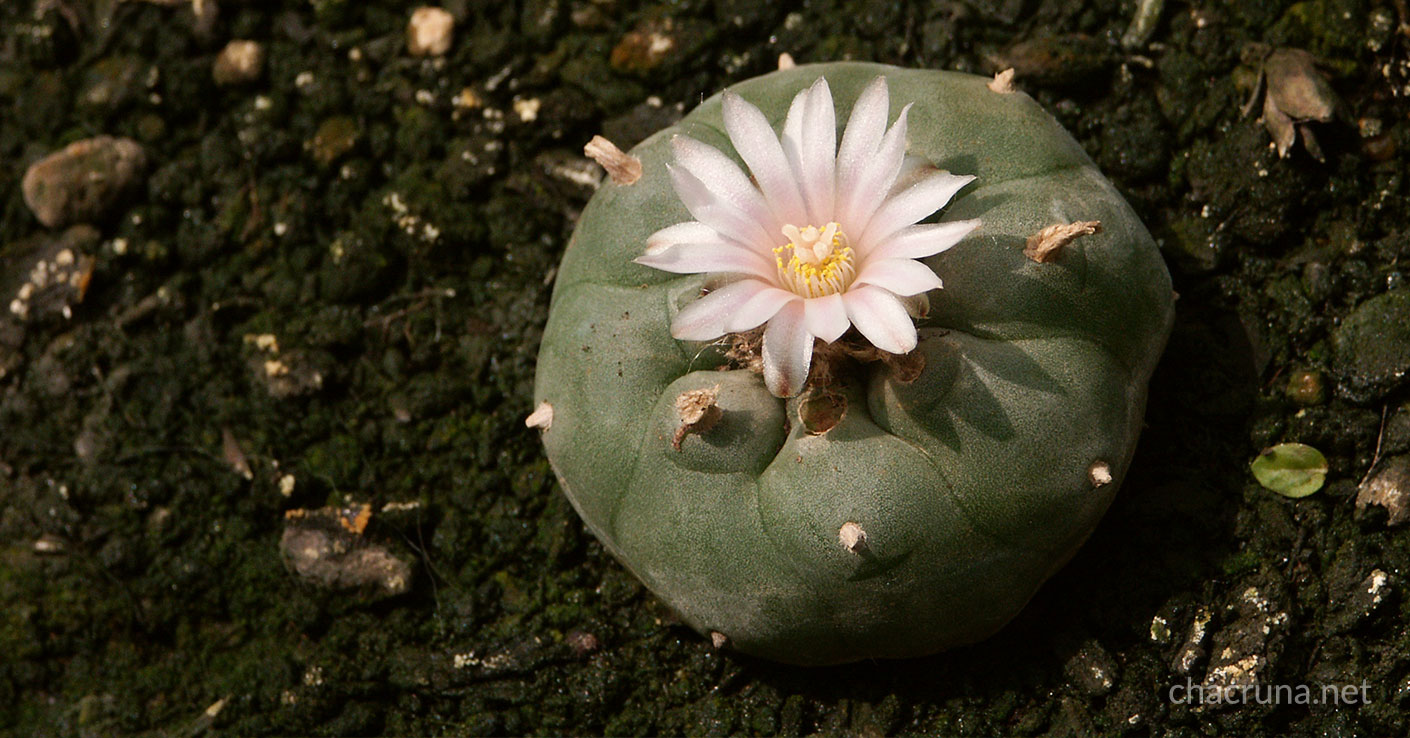 Peyote is a small cactus that contains psychoactive alkaloids, mescaline in particular, which induces similar hallucinogenic effects as psilocybin and LSD. It is native, and considered sacred, in Mexico and southwestern Texas. The Spanish word's roots can be traced to “Nahuatl peyōtl, meaning 'caterpillar cocoon', from a root peyōni, 'to glisten'.” It is known for its mind-altering capabilities and has a long history (5,500 years) of psychedelic and medicinal uses by indigenous people in North America.
Who is Ramón Medina Silva?
Ramón was born, probably in the mid-1920s, in the Huichol community of San Sebastian in the Sierra Madre Occidental. His Huichol name was Ürü Temai, 'Young Arrow', and while his grandfather was a notable mara'akáme, his father was often absent and the family lived in poverty. As a boy, Ramón was bitten by a coral snake, which caused him paralysis in his legs for several months and almost killed him – later in life, Ramón would recognise this as the 'sickness vocation', the calling of a future shaman through illness. His grandfather eventually healed him but not before witnessing Ramón's pledge to 'complete' as a shaman before Tatewarí, Grandfather Fire, and Tayaupá, Father Sun.
As part of his 'completion' as a shaman, Ramón led several pilgrimages to Wirikuta for the famous Peyote Hunt, and although it is not certain whether by the time of his death he had completed the full six pilgrimages usually required to attain the full status of mara'akáme, MacLean reports that even from his first pilgrimage, he developed shamanic abilities very quickly. Furst states however that he completed his training in 1968.
Taken from A Tribute to Ramón Medina Silva with images of his yarn art.
Language Reversal & Defamiliarization
.
The Role of Community
The language changes are neither random nor individual. The mara'akáme (shaman) tells the rest of the group what to call things. This leader not only establishes the vocabulary changes, but teaches and reinforces them.
Cyclical Time
There is a juxtaposition between the time spent in the peyote experience (outside of normal time, fresh, unique, short lasting) and the repeated reminders by the author that this process comes down from the beginning.
References
- .
- .


