This is an old revision of the document!
Table of Contents
The woman who went to the village of the dead (p.317)
By Ajahi Kuikuro (Kuikuro, Brazil, 2004)
Author/Singer and Translators

Figure 1: Bruna Franchetto interviewing Ajahi Kuikuro (2004)
Ájahi Kuikuro is a ritual specialist and expert singer of the female rituals of Kuikuro people, located in Ipatse (Southern Amazonia, State of Mato Grosso, Brazil). In 2004, she agreed to be interviewed to tell a story of her people, as part of the linguistic and anthropological research guided by Bruna Franchetto and Carlos Fausto. Anha ituna tütenhüpe itaõ, ‘The woman who went to the village of the dead’, is a narrative lasting roughly twenty minutes that is part of Kuikuro beliefs.
Bruna Franchetto is a Full Professor in both the Department of Linguistics and the Department of Anthropology (National Museum) at the Federal University of Rio de Janeiro (UFRJ), from which she received her PhD in Social Anthropology in 1986. Since 1977, her linguistic and ethnological research has focused on the Kuikuro and other varieties of the Upper Xingu Carib Language (Southern Amazonia).
Carlos Fausto is a professor of anthropology at the National Museum, Federal University of Rio de Janeiro. He served as a visiting scholar at the universities of Chicago, Stanford and Cambridge, as well as at the École des Hautes Études en Sciences Sociales and the École Pratique des Hautes Études, both in France. He has been conducting fieldwork among indigenous peoples in Amazonia since 1988, most notably with the Tupi-speaking Parakanã and the Karib-speaking Kuikuro.
Poem's structure and Theme
Repetition and Parallelism
The poem uses repetition to emphasize key moments, such as:
lifted her up
lifted her up
lifted her up
This triple repetition gives the moment a ritualistic and rhythmic quality, which aligns with indigenous oral storytelling. It emphasizes the act of ascension, possibly symbolizing a spiritual transition or transformation. Another repeated structure appears in the dialogue sections, where phrases like “LISTEN!” and direct speech by Mother-in-law create a call-and-response dynamic similar to traditional oral narratives.
Fragmentation and Ellipsis
The ellipses (…) at the beginning suggest a continuation of a previous thought, making it feel like an ongoing oral retelling rather than a neatly framed literary piece. Short, fragmented lines create a sense of movement and urgency, especially in dialogue exchanges. The lack of punctuation at times reflects fluidity and natural speech patterns, a hallmark of oral poetry.
Spatial Structure & Movement
The poem is spatially structured to follow the movement between the living world and the world of the dead. The phrase: & both were at the edges of heaven & earth suggests a liminal space, a threshold between existence and the afterlife. This movement is emphasized through structural layering: First, the Widow is physically lifted. Then, the Earth seems upside down as they ascend. The Mother-in-law performs ritual acts (erasing footprints, turning the face down), which reflect transitional or protective measures to avoid interference from the dead.
Theme
The central theme in the poem is the journey between life and death. The Widow and the Mother-in-law physically and spiritually transition from the world of the living to the world of the dead, symbolizing how life and death are interconnected. The phrase “both were at the edges of heaven & earth” suggests that they exist in a liminal space, neither fully alive nor fully dead. This journey reflects many cultural beliefs about the afterlife, where death is not an absolute end but a passage into another realm with its own rules and structures.
The Kuikuro people
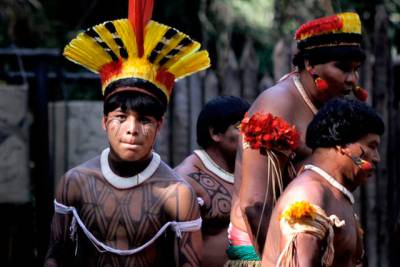
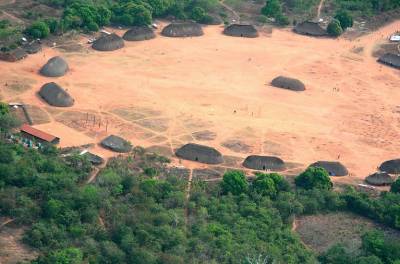
Figures 3 (left) the Kuikuro people and 4 (right) their village.
The Kuikuro people are the largest indigenous population in the Upper Xingu tribe, in the Mato Grosso State in Brazil. It is believed that they inhabited the Xingu River area from around 1,500 to 400 years ago; however, the population may have been reduced by diseases introduced by European explorers since then. Stories of Kuhikugu (original tribal name) may have inspired the British explorer Percy Fawcett to look for the Lost City of Z, in the 1920s, which unfortunately caused his disappearance.
Kuikuro-Kalapalo is a language that is still alive and intact, used by everyone in all domains but not in communication with white people and other Indians. It is mainly a minority language of oral tradition surviving in an unfavorable context for maintaining its vitality. That is the reason why The woman who went to the village of the dead is initially an audio recording transcribed by Linguist Bruna Franchetto.
The woman and the village of the dead
In the Kuikuro beliefs, there is a heavenly world (kahü) whose ‘lord’ is a two-headed vulture and where the dead live in villages. The akunga (‘shadow’, ‘soul’) of the dead person is released from the body, wanders for a certain time amongst the living, and later sets off on a long journey of encounters and battles with birds and monsters that may destroy the akunga. The dead have different destinies depending on the type of death they died.
In the transcription, Ajahi tells the experience of a mother who is taken to the path of the dead (anha) by her mother-in-law so she can see her dead husband, whom she misses so much. They both go up to the skies and turn their faces down so they can see the village. The mother-in-law makes sure to erase her footprints so the dead do not see her. In the village of the dead, people do the same things they used to in their previous lives; however, Ajahi emphasizes how the dead use new words for things such as angagi (strainer) and alato (griddle), tuhagu and igihitolo in the language of the dead. She also said that “kakisukope” (our former language) was reversed,“ in which the suffix -pe, in Kuikuro means previous, ex-. In the full version of the story, the woman sees her dead husband with another woman and returns angrily to the village of the living. Later on, her husband tries to communicate with her in the shape of a bacurau (a local bird), but she mistreats him. He turns into a snake and bites her, which leads to her death.
In addition to exploring the religious aspects and family relationships of the Kuikuro people, the poem brings reflections on the linguistic process that occurs in the world of the dead, where gradually its inhabitants lose the memory of how things are called in our world, replacing our words with an “inverted” or replaced version. This statement presupposes that there is a language that comes after ours but that the language of the living, or the memory of things, still persists in this world.
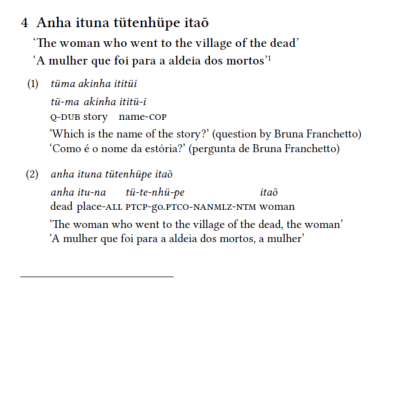 Figure 4: A short introduction to the poem transcription which presents Kuikuro language, as well as its English and Portuguese translations.
References
https://vlv19.abralin.org/en/speaker/bruna-franchetto-2/
Link to the original storytelling video in Kuikuro:
https://zenodo.org/records/997443/files/Anha1.mpg?download=1
Franchetto and Fausto's work, including a link to the transcription from Ajahi's interview. On this and other worlds: Voices from Amazonia


